
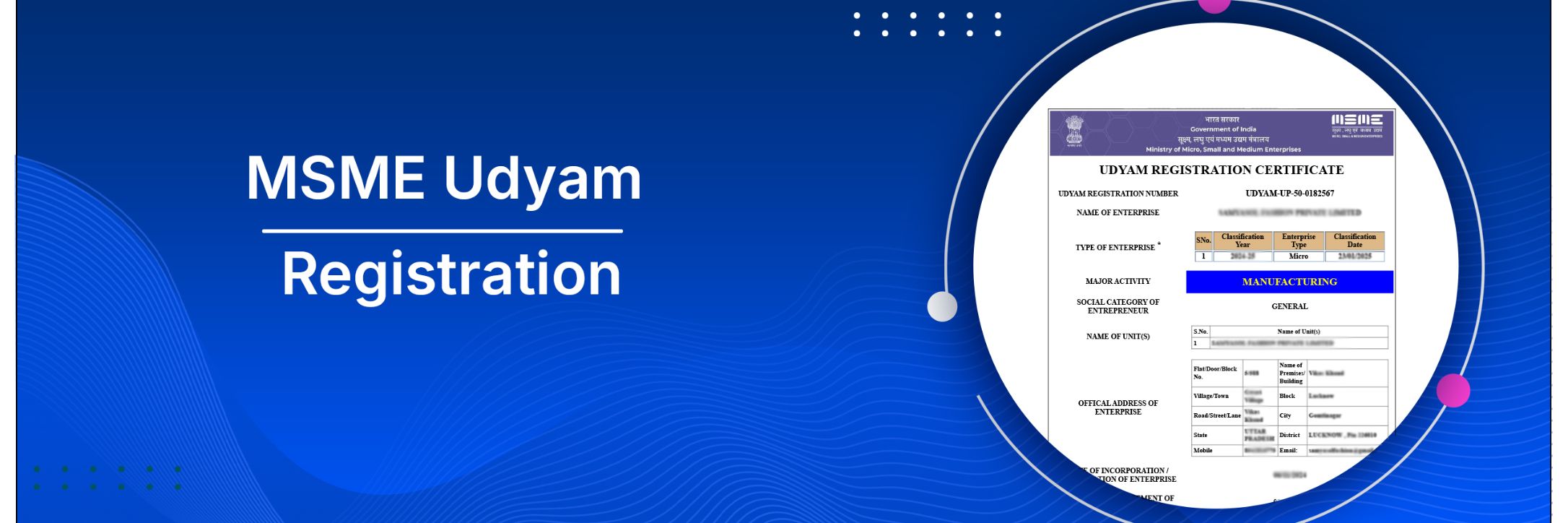
Get formally recognised as a small business, and unlock the benefits that come with it
MSME Registration (also called Udyam Registration) is the process of registering a business under the Micro, Small and Medium Enterprises Development Act, 2006 with the Ministry of MSME, Government of India. It’s a free, entirely online, self-declaration-based registration on the Udyam Registration portal, and classifies your business as Micro, Small, or Medium based on investment in plant/machinery/equipment and annual turnover.
We handle the registration end-to-end, verify your classification is accurate (misclassification can cause problems later), and help you access the schemes and benefits tied to your registered status.
How classification works
| Micro | Small | Medium | |
|---|---|---|---|
| Investment in plant & machinery/equipment | Up to ₹1 crore | Up to ₹10 crore | Up to ₹50 crore |
| Annual turnover | Up to ₹5 crore | Up to ₹50 crore | Up to ₹250 crore |
| Applies to | Manufacturing & service enterprises | Manufacturing & service enterprises | Manufacturing & service enterprises |
A business is classified based on whichever criterion — investment or turnover — places it in the higher category. Both figures are cross-verified against Income Tax Returns and GST returns linked via PAN, since Udyam is now integrated with these systems.
Who should register: proprietorships, partnerships, LLPs, Private Limited companies, and any other business entity engaged in manufacturing or providing services, within the prescribed investment and turnover limits. There’s no restriction on registering a newly incorporated entity from day one.
Typical timeline: Registration is typically instant to 2–3 working days, since it’s a self-declaration-based online process with Aadhaar and PAN verification — no documents need to be uploaded.
Step 1 — Eligibility and classification check
We review your investment in plant/machinery or equipment and your latest turnover figures to confirm which category — Micro, Small, or Medium — your business falls into, and whether you’re eligible to register as a manufacturing or service enterprise.
Step 2 — Aadhaar verification
Registration requires the Aadhaar number of the proprietor (for proprietorships), managing partner (for partnerships/LLPs), or authorised signatory/karta (for companies/HUFs). An OTP is sent to the Aadhaar-linked mobile number for verification.
Step 3 — PAN and GST validation
The business PAN is entered and validated. If GST-registered, GSTIN details are cross-checked; investment and turnover figures are auto-fetched from linked Income Tax and GST records where available.
Step 4 — Udyam Registration form
Business details are filled on the Udyam Registration portal — enterprise name, type of organisation, location of plant/units, NIC code(s) for business activity, number of employees, and investment/turnover figures.
Step 5 — Bank account details
Business bank account number and IFSC code are submitted, used for scheme-linked benefits and subsidy disbursements where applicable.
Step 6 — Self-declaration and submission
Since Udyam is a self-declaration system, no supporting documents are uploaded at this stage — accuracy of the declared figures is the registrant’s responsibility, and is verified against linked IT/GST data.
Step 7 — Udyam Registration Certificate
On successful submission, a Udyam Registration Number (URN) and Certificate are generated instantly, with a permanent registration number and QR code — no renewal is required.
Step 8 — Ongoing reclassification tracking
As turnover or investment changes over time, your classification may shift (e.g. Micro to Small). We help monitor this so you remain correctly classified and don’t lose eligibility for category-specific benefits unexpectedly.
Core requirement
Business details needed for the form
Notes
Priority sector lending and easier credit access
Banks are mandated to lend to MSMEs under priority sector lending norms, often at more favourable interest rates than are available to unregistered businesses, along with collateral-free loans under schemes like CGTMSE.
Protection against delayed payments
Under the MSME Development Act, buyers are legally required to pay registered MSME suppliers within 45 days; delayed payments attract compound interest, and disputes can be escalated to the MSME Samadhaan portal for resolution.
Government tender access and reservations
Many government tenders reserve a portion of procurement specifically for MSMEs, and registered MSMEs get exemption from EMD (Earnest Money Deposit) in several government tenders.
Subsidies and scheme eligibility
Access to schemes covering credit-linked capital subsidies, technology upgradation support, ISO certification reimbursement, patent/trademark registration subsidies, and reduced rates on trademark and patent filing fees.
Tax and regulatory benefits
Certain direct tax benefits and exemptions are available to eligible MSMEs, along with easier compliance under various labour and environmental laws depending on classification and sector.
Electricity bill concessions
Many state governments offer concessions on electricity bills for registered MSME units — the specific benefit and rate vary by state.
Faster access to business support
Registered MSMEs get streamlined access to Udyam-linked schemes, single-window clearances in several states, and eligibility for the Trade Receivables Discounting System (TReDS) for faster invoice financing.
Boosts credibility with lenders and larger buyers
A Udyam Registration Certificate is frequently requested by banks during loan processing and by larger corporates as part of vendor onboarding and MSME-specific procurement compliance.